
Why LangChain? A Deep Dive into the Essential Framework for GenAI
Building with Generative AI today can feel like you’re juggling. You have powerful models from OpenAI, Google, and Meta, but each one hands you a different set of tools. This means the libraries and code you learn for a GPT model don’t directly translate when you want to use Llama 3 or Gemini, leading to a constant, fragmented learning curve.
A developer wanting to use GPT-3.5 would use OpenAI’s specific library, while another using an open-source model from Hugging Face might rely on the Transformers library and its pipeline functionality. This fragmentation created a steep learning curve and made it difficult to switch between models or build applications that could leverage multiple LLMs.
This is the problem that LangChain was built to solve.
The Core Mission: A Unifying Framework
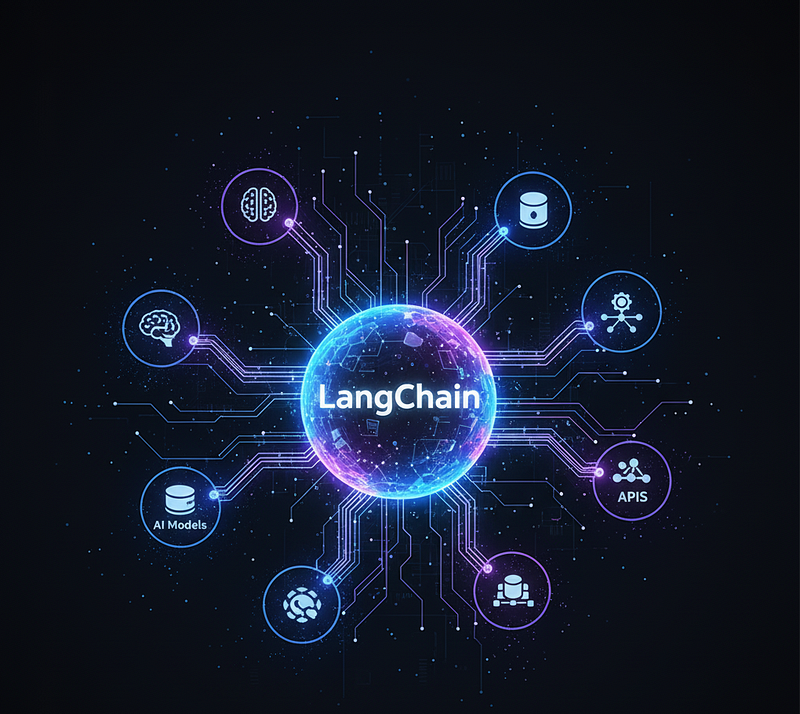
At its heart, LangChain is an open-source framework designed to simplify the development of Generative AI applications.
Instead of learning multiple libraries, LangChain provides a common, standardized interface to interact with a vast array of LLMs. Whether you’re working with a paid API from OpenAI or a self-hosted Llama 3 model, LangChain offers a consistent way to call these models, manage inputs, and process outputs.
This abstraction layer is the primary answer to the question, “Why LangChain?” It streamlines the development process, allowing builders to focus on the application’s logic rather than the boilerplate code required to connect to different models.
From a Library to a Full-Fledged Ecosystem
While LangChain started as a powerful library for building applications, it has evolved into a comprehensive ecosystem that addresses the entire lifecycle of a GenAI project. Building an application is just the first step. To create a robust, production-ready solution, you need to think about what comes next.
This is where the LangChain ecosystem shines. It provides tools for the critical post-development phases, often referred to as LLMOps (Large Language Model Operations).
Let’s break down the key components:
1. LangSmith: The LLMOps Backbone
Once you’ve built your application, how do you ensure it’s working correctly? How do you debug it when it produces unexpected results? How do you monitor its performance over time?
LangSmith is the answer. It’s a platform specifically designed for the operational side of GenAI, providing essential LLMOps capabilities such as:
- Debugging: Trace the exact path of your application’s logic, seeing every call to the LLM, every tool used, and every intermediate step.
- Evaluation: Test your application against predefined datasets to measure its accuracy and performance.
- Monitoring: Keep an eye on your application’s usage, cost, and quality in a production environment.
- Playground: A space for experimenting, annotating data, and refining prompts.
LangSmith gives you the observability needed to move your GenAI project from a prototype to a reliable, production-grade application.
2. LangServe: From Code to Deployed API
After building and testing, the final step is deployment. LangServe simplifies this process by allowing you to easily convert any LangChain “chain” or application into a production-ready REST API.
With just a few lines of code, LangServe handles the complexities of creating an API server, making your GenAI application accessible to other services, front-end interfaces, or users. This makes deploying to cloud platforms like AWS or serverless environments like Hugging Face Spaces incredibly straightforward.
The Building Blocks of LangChain
The ecosystem is powered by a rich set of core components within the main LangChain library. These are the tools you’ll find yourself working with on a daily basis:
- LangChain Community: This houses the vast collection of third-party integrations, providing the connectors to hundreds of LLMs, vector databases, and other tools.
- Chains & Agents: These allow you to structure your application’s logic, from simple sequences of LLM calls (Chains) to complex, autonomous decision-making loops (Agents).
- Retrieval (RAG): This is a critical pattern for building applications that can reason over your own private data. LangChain provides all the necessary components:
- Document Loaders: To ingest data from various sources (PDFs, websites, databases).
- Text Splitters: To break down large documents into manageable chunks.
- Embeddings: To convert text into numerical vectors.
- Vector Stores: Specialized databases for storing and efficiently searching these vectors using techniques like cosine similarity.
- Output Parsers: To structure the raw text output from an LLM into more usable formats, like JSON or Python objects.
Conclusion: Managing the Entire Project Lifecycle
For me, the real power of Langchain isn’t just that it makes development easier, its that it provides a mature, end to end toolkit for the entire lifecycle of the project.
LangChain has cemented its place as the leading framework for GenAI development because it thinks beyond just building. It provides a holistic ecosystem that supports developers through the entire lifecycle of a GenAI project — from initial development and debugging with LangChain, to testing and monitoring with LangSmith, and finally, to easy deployment with LangServe.
By embracing this full-stack approach, LangChain empowers developers to build, iterate, and deploy sophisticated and reliable AI applications faster than ever before.