
How AI Agents Work: A Simple Explanation for Non-Technical Readers
A step-by-step breakdown of AI agents, memory, tools, and large language models — explained simply.
To understand how AI agents work, see below diagram.
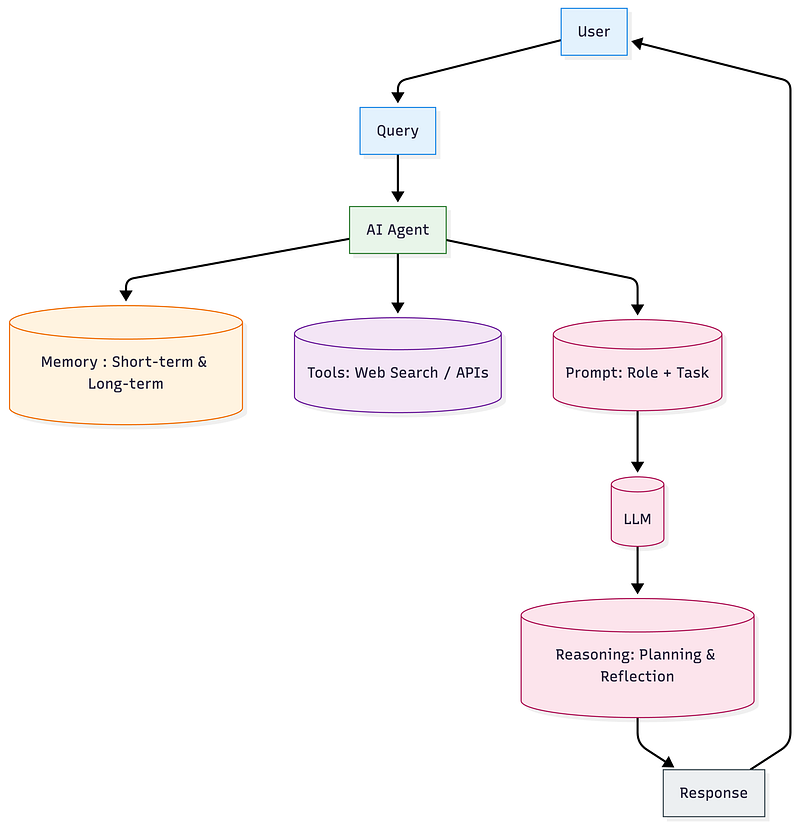
1. User — Where Everything Starts
Everything starts with the user. The user wants something to be done.
Examples:
- Help me find the best mobile under 30000 Rupees
- Write an email response to a job invitation
- Plan a 3-day trip to Goa
2. Query — The User’s Request
When the user types something, it becomes a query.
A query is the raw request sent to the AI agent .
It can be a question, an instruction or a task
Think of the query as:
What does the user want?
3. AI Agent
The AI agent is the brain of the system. It is the central decision maker. It does not write answers itself. It manages the work.
Tools like ChatGPT and Gemini act as AI agents. They understands the query, decides what to do next . It chooses whether to use memory or tools or LLM
In short, The agent plans and controls everything. ItManages the full flow from input → output . It plans, thinks, and acts
4. Memory — Helping the AI Remember
The agent uses memory to avoid starting from zero every time.
Short-term memory
- Remembers the current conversation context , keeps track of what was just said
- For example:
Suppose you asked to summarise a document few messages before and then you say“Make it shorter”, the AI knowswhat “it” refers to*.*
Long-term memory
- Stores important information for future use
- For eg: user preferences, past tasks and so on
Memory helps the AI give consistent and personal answers.
5. Tools
Sometimes the agent needs help from outside . That’s when it uses tools.
Examples:
- The Agent uses Web searchfor real time information like latest prices or news from the web.
- The agent usesApps or APIsto send emails or fetch data or book meetings
6. Language Model (LLM) — The Writer
The agent sends instructions to the LLM.
The LLM is responsible for :
- Understanding the language
- Thinks through the problem
- Writes the response
Important to know:
The language model only does what it is told. There are many language models available today, built by different companies (like GPT, Gemini, Claude, and others), and each has its own strengths, but the AI agent handles this complexity for the user.
7. Prompt — Clear Instructions
Before using the LLM , the agent creates a prompt.
The prompt explains:
- Role — Who the AI should act as For Example:
- “Act as a career coach”
- “Act as a financial advisor”
Task — What needs to be done . For Example:
- “Create a step-by-step career growth plan”
- “Compare phones under ₹30,000”
Good prompt is very crucial for better output.
8. Reasoning — Thinking Before Replying
.The LLM then performs 𝗥𝗲𝗮𝘀𝗼𝗻𝗶𝗻𝗴.
This includes:
𝗮) 𝗣𝗹𝗮𝗻𝗻𝗶𝗻𝗴 • Breaking the task into steps .Deciding the best approach
𝗯) 𝗥𝗲𝗳𝗹𝗲𝗰𝘁𝗶𝗼𝗻 • Checking if the answer makes sense .Improving clarity or fixing mistakes . This is what makes AI feel “smart”.
9. Response — The Final Answer
After reasoning, a response is created. Before sending it back, the agent may:
- Review the response
- Save useful information in memory
Then the answer is ready.
10. Back to the User
The response goes back to the user.
If the user asks again:
- The loop continues
- Memory and context keep improving the experience
- The AI feels more helpful over time